When I was five years old, there was a television show called Dr. Kildare. It was then that I decided that I wanted to become a physician, a surgeon, and save people’s lives when they needed it most. In 1962, very few women were accepted to medical school. I grew up in a world where women were considered too delicate to do the things doctors did. I never believed that. I didn’t wait for doors to be opened for me; I opened them for myself.
I applied to allopathic medical schools with a 3.92 GPA and a 4.0 in the sciences. I was turned down by every school I applied to. I was a divorced, single mother. No one was willing to take a chance on me. My father, who was newly retired, had taken a position at the Osteopathic Hospital in New Berlin, Wisconsin. He brought home information on osteopathic medicine and said, “Honey, I think this is you.” After some research, I applied again, but this time I also applied to the University of Osteopathic Medicine and Health Sciences in Des Moines, Iowa. They requested an interview. I was accepted. At that time, Des Moines boasted that they had the highest percentage of women matriculating that year: 30%. I graduated in 1991 and went on to complete a rotating internship at Memorial Hospital in York, Pennsylvania.
Following my internship, I entered a general surgery residency in Lansing, Michigan and, after three years, changed residency to urology when Michigan State University opened a urology residency program with Shirley Harding, DO, FACOS, and David D. Wartinger, DO, FACOS, as trainers. I was able to spend three months doing subspecialty training with the urologists at the University of Michigan. I then stayed at MSU for seven years following completion of my residency. I was the first urology resident at MSU, the fifth female urologist in Michigan, and the 88th female urologist in the United States.
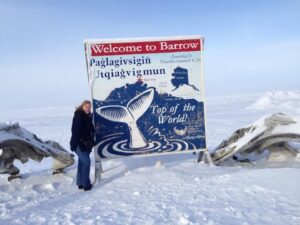
My husband, who is an attorney, was offered a position in Alaska, and since he had lived there previously, we decided to move there for this opportunity. While there, I worked for the Indian Health Service and was based in Anchorage. I flew out to Alaska Bush Hospitals and Regional Service Center Hospitals every other month for a week to provide care for patients. When I moved there, I was the first female urologist in Alaska and the eighth urologist in the state. I currently continue this work to help address the shortage of specialty providers. I fly to Alaska every six weeks and work for a week to provide care to patients who would otherwise have no access to urologic care. There are currently 14 urologists working in Alaska, myself included. While living in Alaska, I became a musher and had a total of 19 dogs. I did race, and I do have a trophy. My team and I came in last. I mush purebred Siberian Huskies. They are slow, strong, and oh, so very beautiful. We are the team that everyone was photographing.
Being semi-retired, I also work part time for the University of Michigan at MyMichigan Health in Midland, Michigan, and Henry Ford Health System in Jackson, Michigan. My husband and I live on my family’s Centennial Farm in Michigan, where I care for a flock of chickens, ducks and geese, along with our four dogs. I hope to fully retire in the next two years.
I have enjoyed serving the ACOS as an oral board examiner, education committee member, discipline chair, and board member. I encourage all members to serve in any capacity, no matter how small. Every contribution, no matter how small, serves to continually improve our organization.